
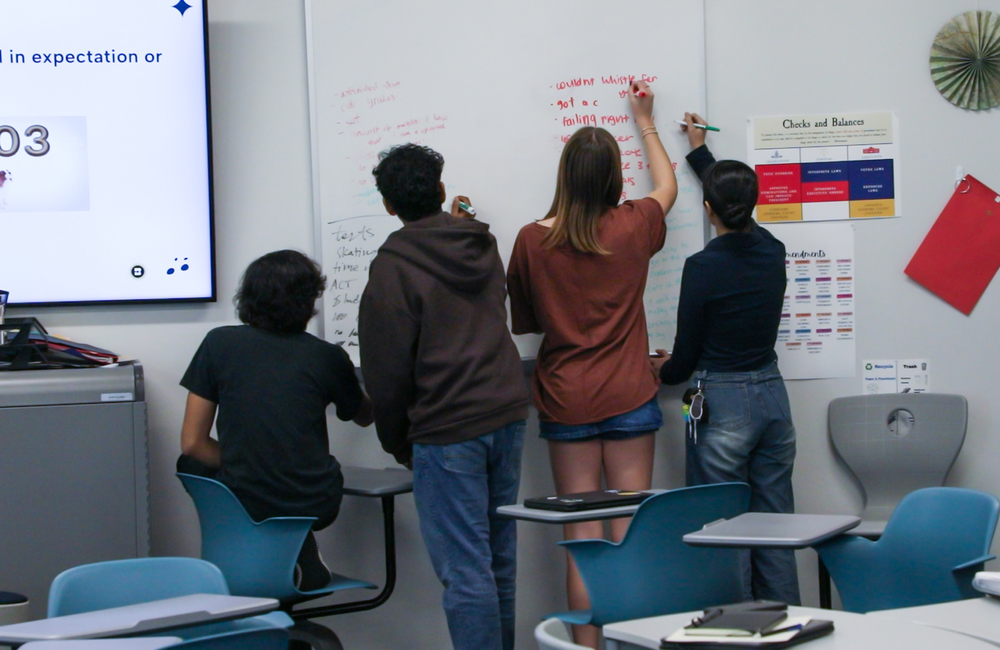
Kyle Wenokur’s GT American Studies students wrapped up a college project by analyzing and embracing the things they could do better.
Failure is a gift that teaches us who we are — an important lesson students learned last month in an Emerson High School classroom.
No, juniors in Kyle Wenokur’s GT American Studies class weren’t receiving F’s on a test. They were developing “failure résumés” as part of a Friend to Failure lesson wrapping up their college project.
“We can look at the times we fail and pull things out of it that teach us something about ourselves,” Wenokur said. “We are not just how we're impacted by art. We're not just the things that we already believe in, but we are the things that we're not good at, too.”
GT American Studies combines AP Language and Composition with AP U.S. History, for students identified as gifted and talented. In the failure lesson, this group of ambitious, success-driven students confronted their own shortcomings — struggling in some cases to even think of something they couldn’t do.
As students wrote their failures on the whiteboard, one girl seemed stumped.
“I can’t think of anything,” she told a classmate, then it came to her. “I can’t whistle!” she said, scribbling that down. Big or little, every failure was worth noting.
To illustrate that, Wenokur gave students four definitions of “failure” and examples from his own life. There was the time his friend snapped his arm throwing a dodgeball, the time he failed to get Latin honors in undergrad, the fact that he can’t keep up with a gluten- or dairy-free diet, that he’s not a more patient driver.
Wenokur said two people were instrumental to his failure lesson: Emerson instructional coach Kate Piatt, who suggested the idea, and his wife, Rachael Wenokur, an instructional coach at Tadlock Elementary School.
One of Wenokur’s own “failure” examples was that he can’t braid his daughter’s hair as well as Rachael can. As Wenokur and the students navigated through the definitions of failure, the tone gradually and intentionally shifted.
“The beginning of the lesson was meant for our guards to come down,” he said, “so that we could then operate within our other learning target, which was to treat failure with honesty. We couldn't do that unless our guards came down a little bit.”
Students laughed along with his examples but were obviously inspired, too.
One girl’s “failure résumé” included a time she was late to her 4 a.m. shift as a lifeguard and her disappointment at not making a top orchestra her freshman year. Another student said she could be a better cook, have a better attention span, be a better athlete.
One student put it simply: “I’m a high school junior, so I mess a lot of things up.”
Wenokur called the failure assignment a success — it was a well-spent day where students celebrated who they are by not only embracing what they could do better, but how natural failure is and how it’s impacted them.
“It’s something we say pretty much every day in this class: If we don't take ourselves too seriously but take the things seriously, I just wonder if we can have a lot of fun doing important things,” he said.
Learn more
Gifted and Talented services are offered for students in grades K-12. There is a three-step identification and placement process for the FISD Gifted/Talented Program.
Services in elementary, middle and high school
2025-26 Academic Course Catalog